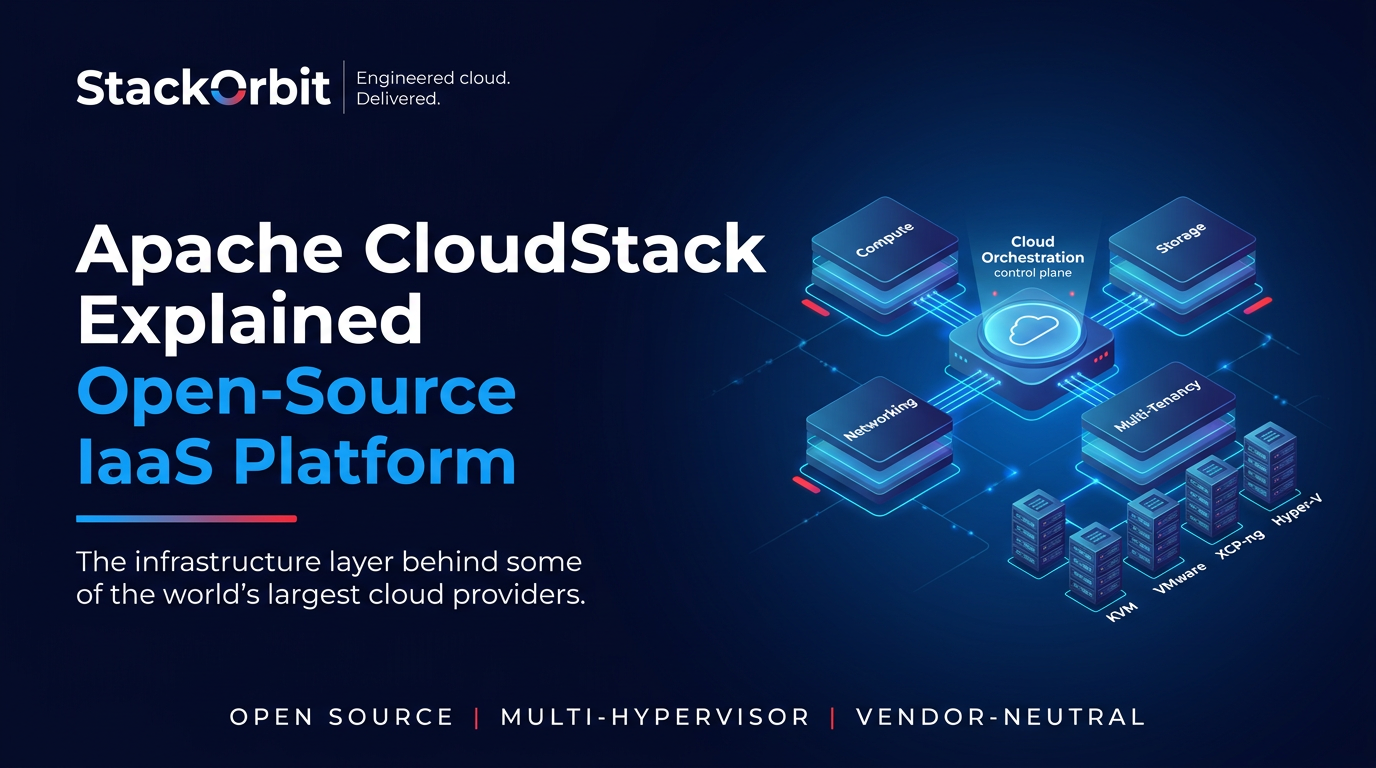
Apache CloudStack Overview: Architecture and Core Capabilities
Apache CloudStack is an open-source Infrastructure-as-a-Service (IaaS) platform used to deploy and manage large networks of virtual machines as a highly available, highly scalable cloud computing environment. It provisions and orchestrates compute, storage, and networking resources across multiple hypervisors and data centers from a single management plane, giving service providers and enterprises the same core capability a hyperscale public cloud offers — self-service virtual machines, isolated tenants, software-defined networking, and centralized control — built on infrastructure they own and operate themselves. It is governed as a Top-Level Project of the Apache Software Foundation (ASF), which means its code, roadmap, and license are controlled by an open community rather than a single vendor.
The Business Case for Apache CloudStack
The short answer: it lets you build and run a cloud business without a vendor deciding what you're allowed to charge for it. Apache CloudStack acts as a vendor-neutral abstraction layer across every major hypervisor — so operators aren't locked into a single hypervisor vendor's roadmap or licensing terms [Apache CloudStack Documentation] (the full supported list is in the FAQ below). It was built from the ground up to manage tens of thousands of physical servers across geographically distributed data centers, with multi-tenancy, automated failover, and cross-zone software-defined networking as native capabilities rather than bolt-ons [Apache CloudStack Documentation]. And because it's genuinely open source, the organizations running it are free to inspect it, modify it, and redistribute it commercially — the platform itself imposes no per-core, per-socket, or per-VM fee.
Governance and Track Record: From Apache Incubation to Top-Level Project
CloudStack's roots go back to 2008, when a company called VMOps — founded by Sheng Liang, Shannon Williams, Alex Huang, Will Chan, and Chiradeep Vittal — set out to build cloud infrastructure software, backed by venture funding from Redpoint Ventures, Nexus Venture Partners, and Index Ventures [Wikipedia]. VMOps rebranded as Cloud.com in 2010 and released most of the platform as free software. Citrix Systems acquired Cloud.com in July 2011 for roughly $200 million, and within a year made the strategic decision to donate the entire codebase to the Apache Software Foundation, which accepted it into incubation in April 2012 under the Apache License 2.0 [Wikipedia]. By March 2013, CloudStack had graduated to a Top-Level Apache project — a status it has held for over a decade [Wikipedia].
That history matters because it explains why CloudStack isn't a scrappy alternative playing catch-up. It's a mature, independently governed project with the release discipline to show for it: the most recent long-term-support release, CloudStack 4.22.1.0 LTS, shipped in May 2026, and the project's public repository shows more than 38,000 commits, 45 releases, and an active base of contributors working through open issues and pull requests every week [GitHub]. Organizations that have run or built on CloudStack over the years include British Telecom, Verizon, Nokia, Orange, Huawei, SAP, Autodesk, Dell, and Disney, among more than 100 others listed by the project itself [Apache CloudStack]— a track record most “emerging” alternatives simply don't have.
Key Advantages of Apache CloudStack for IaaS Providers
For a service provider deciding what to build the next decade of their cloud business on, Apache CloudStack's advantages come down to a handful of concrete points:
- Genuinely open source
Licensed under Apache 2.0 with no restrictions on commercial use, modification, or redistribution — no hidden license cost buried in a renewal quote a year from now.
- Built for scale and flexibility
Manages infrastructure across thousands of hosts and multiple hypervisors without forcing a single-vendor stack.
- An active, independently governed community
A public commit history, a predictable LTS release cadence, and no single company able to unilaterally change its pricing or terms.
- A feature set built for providers, not internal IT
Multi-tenant isolation, self-service provisioning, software-defined networking, high availability, and API-driven automation — designed for operators running a public or large-scale private cloud business.
That combination of openness and flexibility is what makes CloudStack a genuine orchestration layer rather than just another virtualization tool. Because it abstracts compute, storage, and networking across whichever hypervisors an operator already runs, a provider can standardize on one control plane instead of managing a separate toolchain per hypervisor — and can bring new hardware or a new hypervisor into the same environment without re-architecting anything. That flexibility compounds as the estate grows: the same management plane that runs a few dozen hosts in one data center is designed to run tens of thousands of hosts across multiple, geographically distributed zones, with multi-tenancy, automated failover, and cross-zone networking handled natively rather than bolted on.
CloudStack itself is deliberately scoped to the infrastructure layer: compute, storage, and networking, with zero license fee, and nothing else. What it doesn't include — by design, as an infrastructure project — is the commercial layer: billing, metering, customer onboarding, and reseller management. That's a second layer an operator adds on purpose, matched to how they actually want to run their business, rather than one bundled in and priced by a single vendor.
Considering Apache CloudStack for your own platform? Talk to StackOrbit's Apache CloudStack consultants about architecture, hypervisor selection, and a deployment plan built around your environment.
Business Enablement: Turning Infrastructure Into a Monetized Cloud Platform
This is the part most CloudStack conversations skip past, and it's the one that actually determines whether adopting it pays for itself. Infrastructure that's cheaper to run is only worth something if you can still meter it, bill it, and onboard customers onto it — otherwise you've just swapped one free layer in for a business you still can't sell.
This is what the business enablement layer is for, and it's why the two-layer model matters: Apache CloudStack handles compute and networking, and a platform like StackBill — StackOrbit's business enablement platform, installed directly on top of CloudStack — handles usage-based metering, automated quote-to-cash billing, multi-tenant reseller pricing, and self-service customer onboarding. Instead of stitching together an open-source hypervisor layer with a generic third-party billing tool never built for cloud usage metering, operators get one integrated stack purpose-built to run a next-generation, enhanced cloud business end to end.
Getting from “we've decided to adopt Apache CloudStack” to “we're running a fully monetized cloud business on it” is exactly where most in-house teams stall — which is why it's typically done with expert help rather than alone. StackOrbit's Apache CloudStack consulting service is where that work happens end to end: architecture design and hypervisor selection, deployment and integration, optimization and training, and ongoing 24/7 managed operations, so adopting Apache CloudStack is planned and supported at every stage rather than improvised.
Frequently Asked Questions
What Is Apache CloudStack Used For?
Apache CloudStack is used to build and operate Infrastructure-as-a-Service clouds — the orchestration layer that turns a pool of physical servers into self-service virtual machines, isolated tenant environments, and software-defined networks, whether the deployment is a public cloud sold to customers or a large-scale private cloud run internally.
Is Apache CloudStack Really Free to Use Commercially?
Yes. It's licensed under Apache 2.0, which places no restrictions on commercial use, modification, or redistribution, and the platform itself carries no per-core, per-socket, or per-VM license fee — an operator's only costs are the infrastructure it runs on and whatever commercial or support layer it chooses to add.
Which Hypervisors Does Apache CloudStack Support?
CloudStack acts as a vendor-neutral abstraction layer across multiple hypervisors, including KVM, VMware vSphere, Citrix XenServer/XCP-ng, and Hyper-V, so an operator isn't locked into a single hypervisor vendor's roadmap or licensing terms.
Who Governs Apache CloudStack, and Is It Actively Maintained?
CloudStack has been a Top-Level Project of the Apache Software Foundation since March 2013, governed by an open community rather than a single company. It ships roughly two major releases a year, and its public repository shows more than 38,000 commits and 45 releases, with contributors actively working through issues and pull requests every week.
Does Apache CloudStack Include Billing and Customer Management?
No — by design, CloudStack is scoped to the infrastructure layer: compute, storage, and networking. Usage-based metering, quote-to-cash billing, reseller pricing, and self-service onboarding are a separate, deliberate layer that operators add on top, such as StackOrbit's StackBill platform.
How Do I Get Started Deploying Apache CloudStack?
Most operators start with an architecture and business-case assessment before committing to a build — hypervisor selection, capacity planning, and a deployment roadmap matched to the environment. StackOrbit's Apache CloudStack consulting service handles that assessment through to deployment and ongoing 24/7 managed operations.
Choosing an orchestration layer is a decision that compounds for years — in what it costs, how it scales, and how much control a single vendor has over your roadmap. Apache CloudStack's combination of zero license fees, genuine hypervisor flexibility, and an actively governed, independent community is why it keeps being the platform service providers standardize on for the long term.
Published by StackOrbit — follow us on LinkedIn for more on Apache CloudStack, open-source cloud infrastructure, and public cloud business enablement.
Sources:
- Apache CloudStack Documentation — Concepts and Terminology
- Wikipedia — Apache CloudStack
- GitHub — apache/cloudstack
- Apache CloudStack — Users