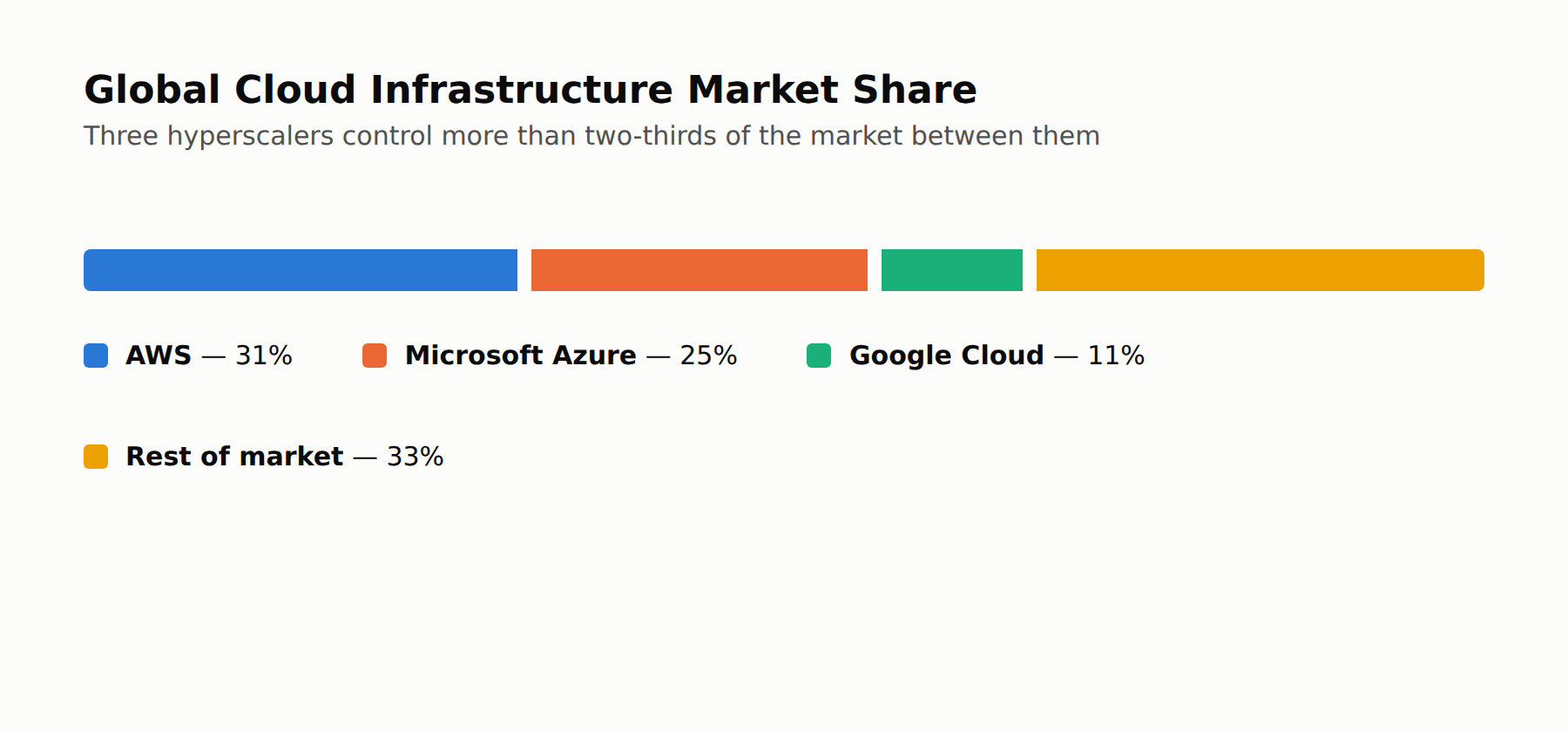
Three hyperscalers now control more than two-thirds of the global cloud infrastructure market between them — AWS holds roughly 31%, Microsoft Azure 25%, and Google Cloud 11% [Holori]. By most conventional measures, that's efficiency. Massive scale, constant innovation, a platform for almost anything.
It's also exactly the problem regulators, boards, and increasingly your own customers have started asking hard questions about.
Three years of accelerating sovereign cloud market growth
The market size in numbers
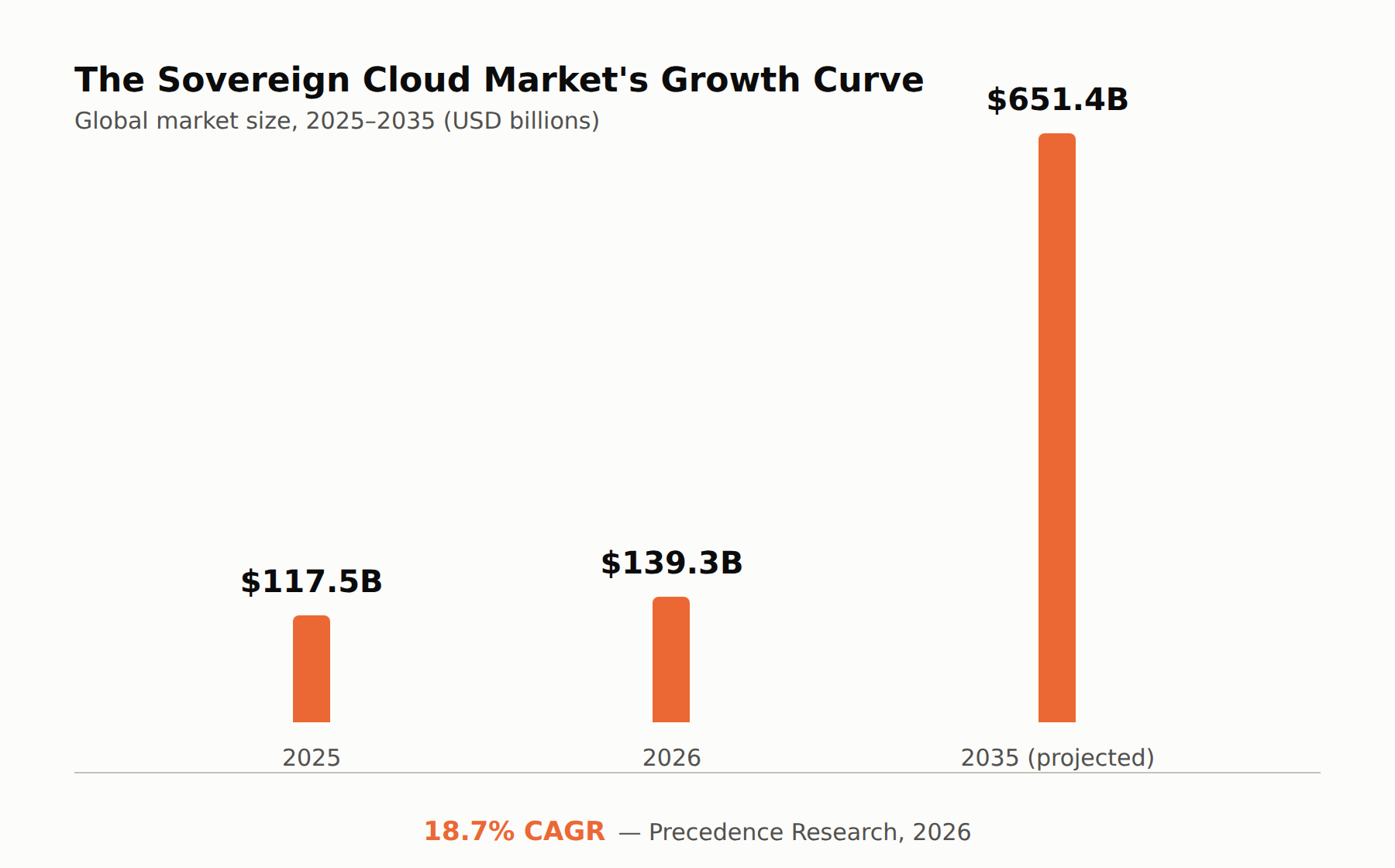
The sovereign cloud market was valued at roughly $117.5 billion in 2025, is projected to reach $139.3 billion in 2026, and is on track for $651.4 billion by 2035 — a compound annual growth rate of 18.7% [Precedence Research]. Asia-Pacific is the fastest-growing region at 22.1% CAGR, and the European Commission alone has earmarked €1.3 billion for sovereign cloud infrastructure between 2025 and 2027 [Precedence Research].
Gartner's term for this shift: Geopatriation
Gartner has a name for what's driving this: “Geopatriation” — organizations deliberately pulling critical workloads back under regional or national control in response to geopolitical instability, rather than leaving them with providers headquartered somewhere else entirely [Virtualization Review]. The firm has gone as far as renaming its flagship cloud assessment from “Cloud Infrastructure and Platform Services” to “Strategic Cloud Platform Services” — a signal that trust and jurisdiction now matter as much as feature checklists [Virtualization Review].
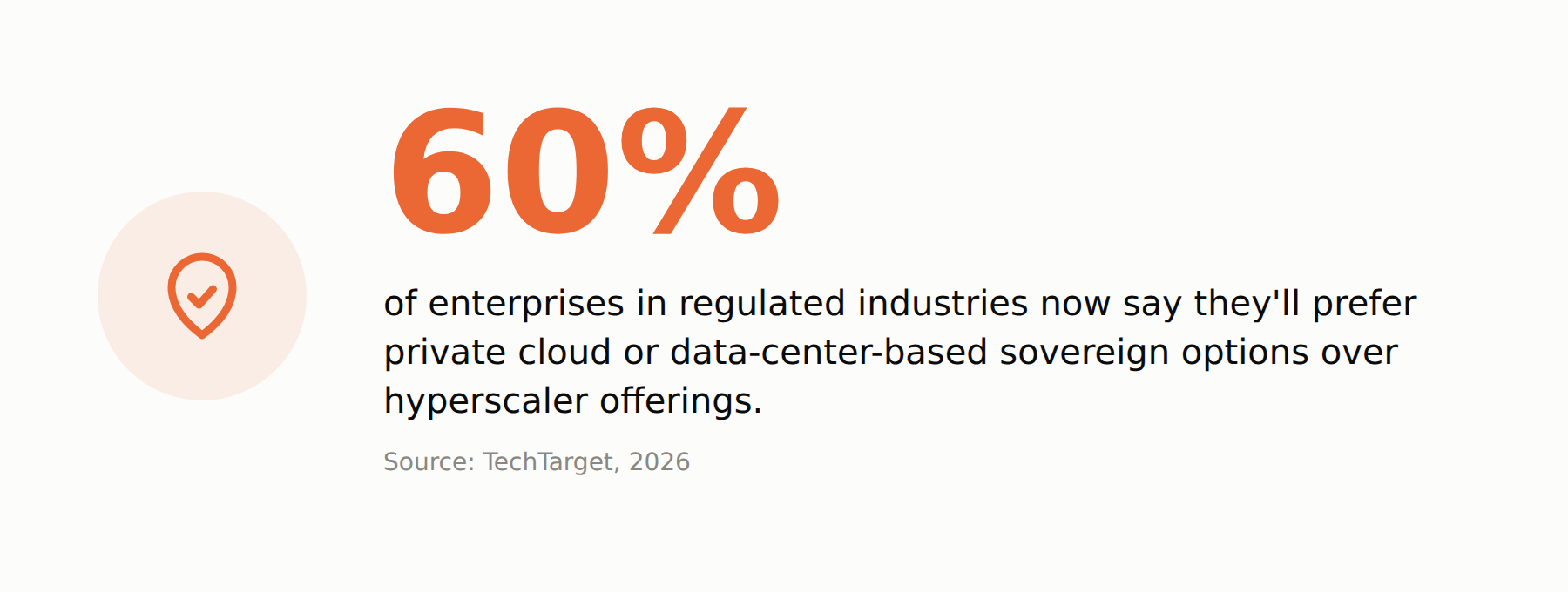
The data backs it up: 60% of enterprises in regulated industries now say they'll prefer private cloud or data-center-based sovereign options over hyperscaler offerings [TechTarget].
The implications for a regional operator
For a hyperscaler with a presence on every continent, that's a diversification footnote. For a regional operator, it's close to the whole addressable market walking in the door at once — because those enterprises don't have a long list of sovereign providers to choose between in their own jurisdiction; they have however many exist today, plus whoever moves first. The $651.4 billion a market analyst is forecasting for 2035 isn't demand you have to go create. It's demand that's already been told, by its own regulators, to go find someone like you.
Sovereignty is not a compliance checkbox anymore — it's a market
If your data center serves customers in more than one jurisdiction, you've probably already felt this shift firsthand. In India, payment system data has been required to stay within the country since 2018 [RBI], the DPDP Act gives government the power to restrict cross-border transfers by notification [MediaNama], and government workloads specifically must run on sovereign, empanelled Indian clouds [Spice Route Legal]. Similar patterns are playing out across the EU, the Middle East, and Asia-Pacific, each with its own version of the same underlying demand: prove where the data lives, prove who can access it, and prove you can keep proving it.
Here's the opportunity most data center leaders miss in that requirement: it isn't only a cost of doing business. Every enterprise that can't meet a hyperscaler's jurisdiction on its terms is a customer looking for exactly what a regional operator is positioned to offer — infrastructure that's demonstrably local, accountable, and built on open standards instead of a single vendor's roadmap.
The requirements for building a real sovereign cloud
This is where most conversations about “sovereign cloud” stay too abstract to act on. In practice, it comes down to four hard requirements:
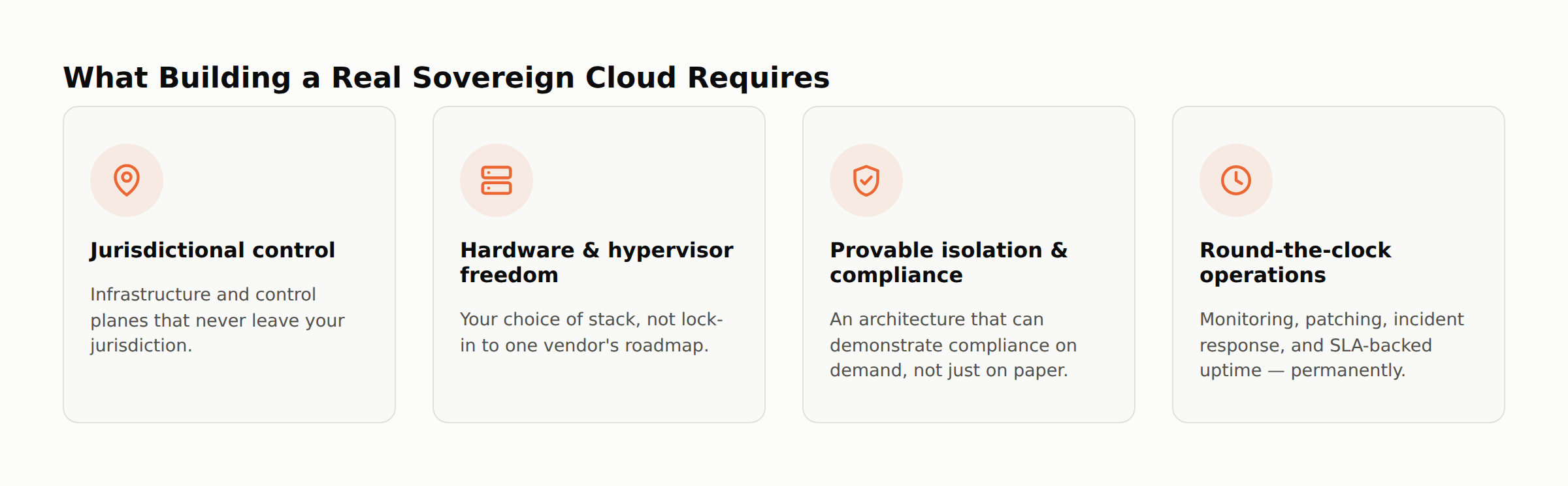
- Jurisdictional control. Infrastructure and control planes that stay inside your jurisdiction — not just the data, but who can reach it and under what legal authority.
- Hardware and hypervisor freedom. Your choice of stack, rather than being locked to one vendor's roadmap.
- Provable isolation and compliance. An architecture that can demonstrate isolation and compliance on demand, not just claim it on paper.
- Round-the-clock operational discipline. The part almost nobody budgets for: monitoring, patching, incident response, and SLA-backed uptime — permanently, not just at launch.
That last requirement is where sovereign cloud projects most often stall. Standing up the infrastructure is a finite project. Running it — with 24/7/365 monitoring, security patching, incident response, and SLA-backed uptime — is a permanent commitment. Get it wrong, and you're not the operator who wins the enterprise that just got told to bring its workloads home; you're the one they cite when a regulator asks why the “sovereign” provider they chose couldn't produce an uptime record or an audit trail on demand.
Key considerations before you commit
Before choosing how to build — or who to build with — a sovereign cloud strategy stands or falls on a short list of decisions:
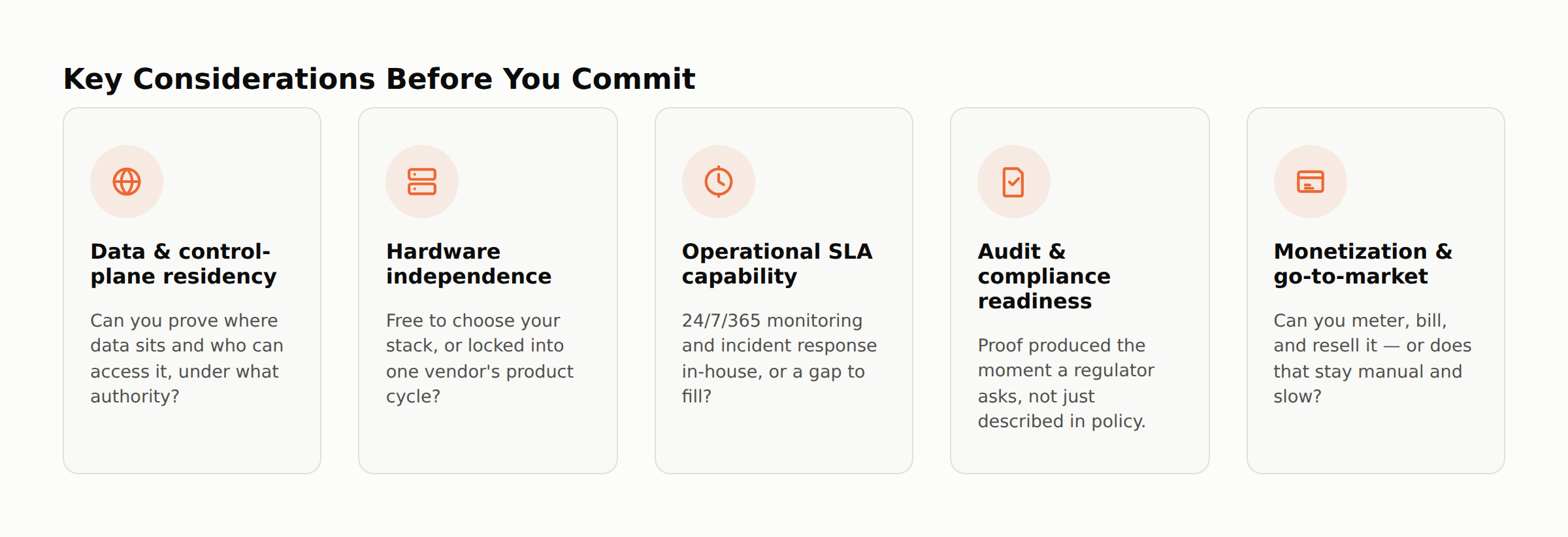
- Data and control-plane residency. Can you prove not just where data sits, but who can access it and under what legal authority?
- Hardware and hypervisor independence.Are you free to choose your stack, or locked into one vendor's product cycle?
- Operational SLA capability.Do you have 24/7/365 monitoring, patching, and incident response in-house — or is that a gap you'd be building sovereignty on top of?
- Audit and compliance readiness. Can you produce isolation and compliance proof the moment a regulator or customer asks, not just describe it in a policy document?
- Monetization and go-to-market. Once the infrastructure is compliant, can you actually meter, bill, and resell it — or does that stay a manual, spreadsheet-driven process?
StackOrbit's approach to this shift
Getting the infrastructure right is the table-stakes half of this. StackOrbit's Apache CloudStack consulting engagement handles that end — assessment, deployment, and 24/7/365 SLA-backed support across your environment, backed by a team that's taken more than 100 deployments live globally, so you're not left running a sovereign cloud unsupported six months in.
But solving where your infrastructure lives was never the hard part of this shift — it's the part every regulator's checklist already tells you how to pass. The question no compliance framework answers is what that infrastructure makes you as a business. Most sovereign cloud builds treat monetization as an afterthought: the compute is compliant, the data never leaves the jurisdiction, and there's still no clean way to meter it, bill for it, or sell it to a reseller without a spreadsheet and a support ticket.
That's the layer StackBill is built to close. It's StackOrbit's cloud billing and business platform for Apache CloudStack — usage-based metering across compute, storage, and bandwidth, automated quote-to-cash billing, multi-tenant and reseller pricing, and self-service provisioning your customers can use without opening a ticket. It's the same open, Anything-as-a-Service model, purpose-built for sovereign cloud markets: the infrastructure you've made compliant becomes infrastructure that pays for itself and keeps growing, without you rebuilding a billing stack from scratch alongside the NOC you already had to stand up.
The next wave of cloud growth isn't going to hyperscalers with the biggest global footprint. It's going to the operators who can prove their infrastructure is local and controlled — and turn that proof into a business.
Frequently asked questions
What actually makes a cloud "sovereign" — isn't it just where the servers are physically located?
Physical location is the starting point, not the whole answer. A true sovereign cloud also means the control plane, the encryption keys, and the operational access all stay inside the jurisdiction — so a regulator can verify not just where the data sits, but who can reach it and under what legal authority. Infrastructure that's locally hosted but still managed or accessed through a foreign vendor's stack doesn't clear that bar.
Do we need to replace our existing infrastructure to build a sovereign cloud, or can we build on what we already run?
In most cases, no rip-and-replace is needed. Apache CloudStack is hardware- and hypervisor-agnostic — KVM, XCP-ng, or VMware — so a CloudStack design and build engagement is typically about bringing your existing environment up to a sovereign, auditable standard rather than starting over. The bigger gap is usually operational, not physical: most regional operators have the hardware, not the 24/7 monitoring and compliance-proof processes to run it as a sovereign offering.
Why does billing and monetization matter as much as compliance in a sovereign cloud strategy?
Because passing a compliance audit doesn't generate revenue on its own. Enterprises relocating workloads under regulatory pressure still expect the usage-based pricing, self-service provisioning, and reseller-ready billing that StackBill is built to handle — the same commercial experience they had with a hyperscaler. Without that layer, a compliant sovereign cloud stays a cost center instead of becoming the recurring-revenue business it's capable of being.
Can a regional or mid-size operator realistically compete with hyperscalers here, or is sovereignty just a consolation prize for smaller players?
This is one market where scale isn't the deciding advantage. Regulators and enterprise customers are specifically seeking providers that aren't the biggest global names, because jurisdiction and accountability are the point. StackOrbit's datacenter solutions are built around exactly this: a regional operator with the right infrastructure and 24/7 operational support is often better positioned to win this demand than a hyperscaler trying to retrofit a sovereign offering onto a global architecture.
Is StackOrbit's involvement a one-time consulting project, or an ongoing partnership?
It's structured as both, deliberately. The CloudStack consulting engagement covers assessment through deployment, but the stage most sovereign cloud builds skip — 24/7/365 SLA-backed managed support — is where StackOrbit stays involved for the life of the environment. StackBill then layers on as the standing platform for metering, billing, and customer self-service, so the relationship doesn't end when the infrastructure goes live.
Published by StackOrbit — follow us on LinkedIn for more on sovereign cloud, CloudStack, and cloud business enablement.
Sources:
- Holori — Cloud Market Share 2026: Top Cloud Providers and Trends
- TechTarget — AI Will Heavily Influence Cloud-Related Decisions in 2026
- Precedence Research — Sovereign Cloud Market
- Virtualization Review — Sovereignty Joins AI as the New Hyperscaler Battleground
- Reserve Bank of India — Storage of Payment System Data FAQs
- MediaNama — India's DPDP Rules: Cross-Border Data Transfers Explained
- Spice Route Legal — Cloud Governance 101: Public Procurement of Cloud Services